The generations on either side of me link me to my past and my future. My view of family history involves revealing the roots and the branches.

Throughout this blog you will find perspectives related to the doctrines of temple and family history work from revealed revelation given to living prophets of The Church of Jesus Christ of Latter-day Saints.

Showing posts with label Family History Library. Show all posts

Saturday, February 27, 2016

Family History Library Block Party - Save the Date - June 11


We LOVED this party last year and can't wait for it this year. Our kids ask about it every time we are in downtown Salt Lake City. 

Put this on your calendars and plan to attend. It is a FUN and FREE event.

You can read about our experience last year (part of the Global Family Reunion), here: 

Thursday, October 29, 2015

From Hours to Seconds - Time to Find a Record


The FamilySearch Family History Library just turned 30! I remember going to the library as a teenager in the late 1980's. At the time, I didn't know the library was "new" as it was all new to me; family history, microfilm, old books. I remember spending entire days there with my father as we searched and searched through microfilm trying to locate just one document about his family.

Recently I was able to quickly access some of those same records we found nearly 30 years ago right from my home computer. Technology is amazing! I think the above infographic is a great representation of what I have personally experienced.

As I started this post, I felt inspired to share this quote from Elder David B. Haight about technology from 22 years ago:

“The Lord has poured out His Spirit upon His children—which is manifest in new technology, simplified procedures, and expanding resources, which enable us to accelerate our progress in the redemption of the dead.”  
– Elder David B. Haight, “Personal Temple Worship,” Ensign, May 1993, p. 25.

I can't wait to see what technology changes the next 30 years bring!

FamilySearch's Family History Library Celebrates 30th Anniversary


FamilySearch’s Family History Library (FHL) in downtown Salt Lake City, Utah, celebrated its 30th anniversary on October 23, 2015. When the new facility was completed in 1985, The Church of Jesus Christ of Latter-day Saints was already considered the foremost authority on family history research. During the past three decades, the library has been hailed by genealogists as the top research and collections library in the world—a designation it still maintains—in part, because it has evolved to keep pace with the changing demographics and demands of family researchers and the communities it serves. 

“The Family History Library in Salt Lake City is unique in all the world,” said Diane Loosle, director of the world-renowned library. She explained the focus of the library has always been to increase access to the world’s genealogical records and help patrons make personal family discoveries.  

“To the family historian, this library is like Disneyland,” says Loosle, “There’s no place like it. People dream for years of coming. It is the largest facility of its kind and the largest of FamilySearch’s 4883 family history centers globally. Many people begin their journey of discovery at one of our facilities.” 

The Family History Library has been attracting guests and visitors from all corners of the world for three decades due to its expansive collection of resources and knowledgeable staff. “Most mornings before the library opens, people begin to queue up in front of the doors waiting to get in,” Loosle said.  

It appears the masterminds behind its construction had a vision of future demands. Plans that seemed almost grandiose when construction of the edifice was announced in 1983 have not only materialized, but have also led the way through the years to accommodate ever-improving research and information gathering options. It has come a long way since its humble beginnings in 1894 as a one- room repository of the Genealogical Society of Utah, just around the corner and up the street in a small building called the Church Historian’s Office at 58 E. South Temple. 

The five-story building in downtown Salt Lake City today continues to serve as a repository and physical point of access for FamilySearch’s now billions of records. Instead of growing numbers of microfilm and microfiche, the influx of new records today continues digitally through online indexing, patron submissions, partner exchanges, donations from various government, religious and private entities and local records preservation and access initiatives world-wide—most of which is made available at FamilySearch.org. 

The library continues to move with digital innovations, benefiting from the latest technology to preserve and provide access to the world’s genealogical records and increase the success of personal discovery. Progress in gathering, copying, and making records available has been dramatic and fast. Over 300 camera teams are digitally preserving historic records worldwide—over 100 million images per year—that are published directly online.  
In this age of 24/7 access to information and growing thirst for digital services, libraries across the nation are evolving to meet the changing demands of the communities and patrons they serve, and the Family History Library is no exception.  

About 25 percent of the 2.4 million rolls of microfilm stored at the Granite Mountain Vault have been digitally published online. The Family History Library itself has about 1.5 million rolls on site. As physical films are digitized, they are removed from the library. Insofar as possible, the records teams plan on digitally publishing all of the microfilm online for 24/7 access. 

In 1985 family history research was a very individual experience requiring each person interested in a specific record to scroll through microfilm or search microfiche. In 1985 over 600 microfilm and fiche readers were housed in the Library. Though microfilms and fiche still play an important, though less frequently used role, a large portion of today’s research is now computer-based. Today the Family History Library boasts 550 Internet-enabled patron computers while still providing access to over 200 film and fiche readers. The Library also offers free access to film, book, and photo scanning equipment to help patrons digitally preserve and share family records.  

The library is the hub of a worldwide genealogical library system—including 4,883 satellite branches in more than 100 countries—called FamilySearch Family History Centers or affiliate libraries.  The library began serving about 2,000 patrons a day or 700,000 a year in 1985, and today, with FamilySearch.org and its satellite branches, it serves over 45 million guests per year.   

“We know that many people will never have the opportunity to visit the Family History Library in person,” said Loosle. “So FamilySearch has been expanding its reach. We want everyone who desires to discover their ancestors to be able to do so, no matter where they live.” 

Managing the Library Requires a Village 
Visitors to the Family History Library find an amazing collection of resources collected over 120 years and hosts of friendly people with expertise available to help them. The Library delivers with an impressive cadre of 45 full and part-time staff, and perhaps unprecedented for libraries, 550 full- and part-time volunteers or “missionaries.”  The volunteers hail from all over the world, many of them dedicating up to 18 months—at their own expense—to help patrons make successful discoveries. 

The main floor of the library is specifically designed to assist inexperienced patrons in getting started. The floor has been outfitted with computers supported by volunteers trained to assist beginners. Volunteers and expert reference staff are also available for more in-depth research on the other floors dedicated to records from certain areas of the world.   

On its lower level, for example, is found the largest number of Chinese clan genealogies outside Mainland China.  This level is also used for storing family histories, and overflow films, and books available by request.  Requests for digitalization of these and other personal books can be requested here, and is  done at another facility in Salt Lake or at many of the Family History Centers and affiliate libraries.   

“The library is not a repository for original documents as is the case with specialized archives; it is not an archive in that sense,” noted David Rencher, chief genealogy officer for FamilySearch.  “But it accepts donations of published works of genealogical significance.”  Books and serials are continually added to the library’s shelves—over 600,000 in fact—and the library is heading up an initiative with other public libraries to digitally publish historic books of genealogical relevance online—over 225,000 have been digitally published online to-date.  

Future of the Family History Library 
The library is focused on continuing to expand access to the world’s genealogical record collections to satisfy growing consumer demands.  In 1985, the average patron was mostly retirees or professional researchers.  “Today, the patron faces are changing.  It is common to see working professionals, families, and even a growing number of youth amidst the stereotypical retirees and serious researchers,” said Loosle.  
  
Loosle sees a bright future for the library. “The library is still the best place to do family history research and will continue to serve that purpose.” In addition, the library has created a lab for testing discovery concepts called the Discovery Center, a family-friendly area where families, and particularly young people, can begin the journey of self and family discovery through fun and engaging activities.  Over time, similar experiences are planned to be incorporated in the Family History Library. We anticipate the exciting additions will attract thousands of new patrons who want to discover their family history. 
  
The library will continue to develop and offer timely, free guest classes broadcasted as webinars.   The schedules, necessary connection links, downloadable handouts, and recordings to past webinars are accessible online through the FamilySearch Wiki. 

The library also hosts a community block party in June.  This year over 3,200 participants came and enjoyed a free family day including bounce houses, face painting, cultural entertainment, family history centric activities and classes.  The 2016 party is tentatively scheduled for Saturday, June 11.  


Begin your family discovery at the Family History Library, online at FamilySearch.org or through a local FamilySearch Family History Center.   


Saturday, June 6, 2015

Global Family Reunion Block Party - Salt Lake City


Today, we attended the Global Family Reunion Block Party in Salt Lake City at the Family History Library. West Temple Street between North and South Temple Streets was blocked off for this party. It was one of over 40 branch parties of the larger Global Family Reunion that was taking place in Queens, New York at the New York Hall of Science.

We arrived just as the event was starting at 10 am and were each tagged with neon green wrist bands. My children immediately wanted to play on the bounce houses that were lining the street.


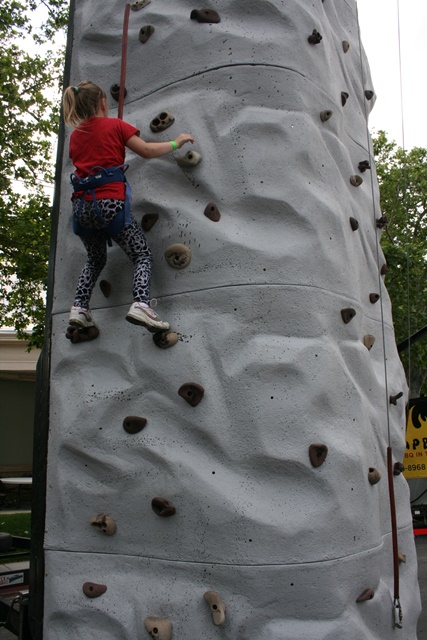
After 5 or 6 bounce houses, we got in line for the rock wall. My children are 7 and 4 and have never climbed one before. I was surprised they wanted to. They were both so brave. As we waited in line, I thought about the bounce houses, the rock wall, the carnival games and realized that I need to step up my games for family reunions. This was so much fun for the kids.


While the kids were in line for the rock wall, I was in the group photo in front of the Family History Library. Each of the block parties as well as the main event had a huge group photo taken. Can you find me?


At each of the carnival games (ring toss, bean bag toss, fish pond, and basketball hoop) the kids got little trinkets or toys for participating. We have leis, bracelets, skin stickers (tattoos), pens, magnet clips, and suckers. They loved the carnival games and repeated them. I love this picture with the missionary who was helping at this booth. I wonder if he ever dreamed that when he accepted his call to be a family history missionary that he would one day be hosting a carnival game for part of the world's largest family reunion.

While we were waiting in line for the face painting, we listened and watched the Polynesian Dancers, the Scottish Bagpipers and Storyteller Elaine Brewster.


We went into the Family History Library for other activities. One of the activities was Replace a Face interactive photos. We chose an old photo and then using the camera on the computer took our picture and the program placed it inside of the picture. Here are Emma's and Matthew's pictures. This would be something fun to do at a family reunion using old pictures of our ancestors.


We also put a dot on a large world map indicating an area where one of our ancestors were from. And we had some other pictures taken of us in front of a green screen and we got to pick out different backgrounds.

The library now has an area with children's toys and a table and white board for children to use. My children immediately sat down and colored away. My daughter colored a huge red heart ... turning hearts to our fathers ... very clever. Good teaching moments even with a coloring page.

The library also had three rotating beginner's classes: Find an Ancestor on FamilySearch.org, Help Me Find a Name, and Beginning Indexing. Also in the library one could watch the live stream from the New York event.

Here is a view of West Temple Street from the 3rd floor of the Family History Library.


I love this banner! It hangs on the front of the Family History Library. I really believe that through family history you can really find your true self. Family History helps me understand who I am, where I came from, and it is the legacy I will leave for my own children.


While we were in the library I was interviewed by a reporter for the Deseret News. You can read that article here:

Deseret News: Salt Lake City joins Global Family Reunion, celebrating family history

KSL: Salt Lake City joins Global Family Reunion, celebrating family history


#GlobalFamilyReunion